



When two articles are targeting the exact same keyword, they will completely rank differently on Google. One reaches page one, while the other gets buried.
The reason isn’t just keywords or backlinks anymore. It comes down to trust. Google wants to make sure the content it shows comes from real people with real experience and proven expertise. That is the role of what we call in SEO E-E-A-T.
In this guide, we will explain “what is E-E-A-T in SEO”, why it matters for your website, and how you can use it to build long-term search authority.
What does E-E-A-T stand for in SEO?
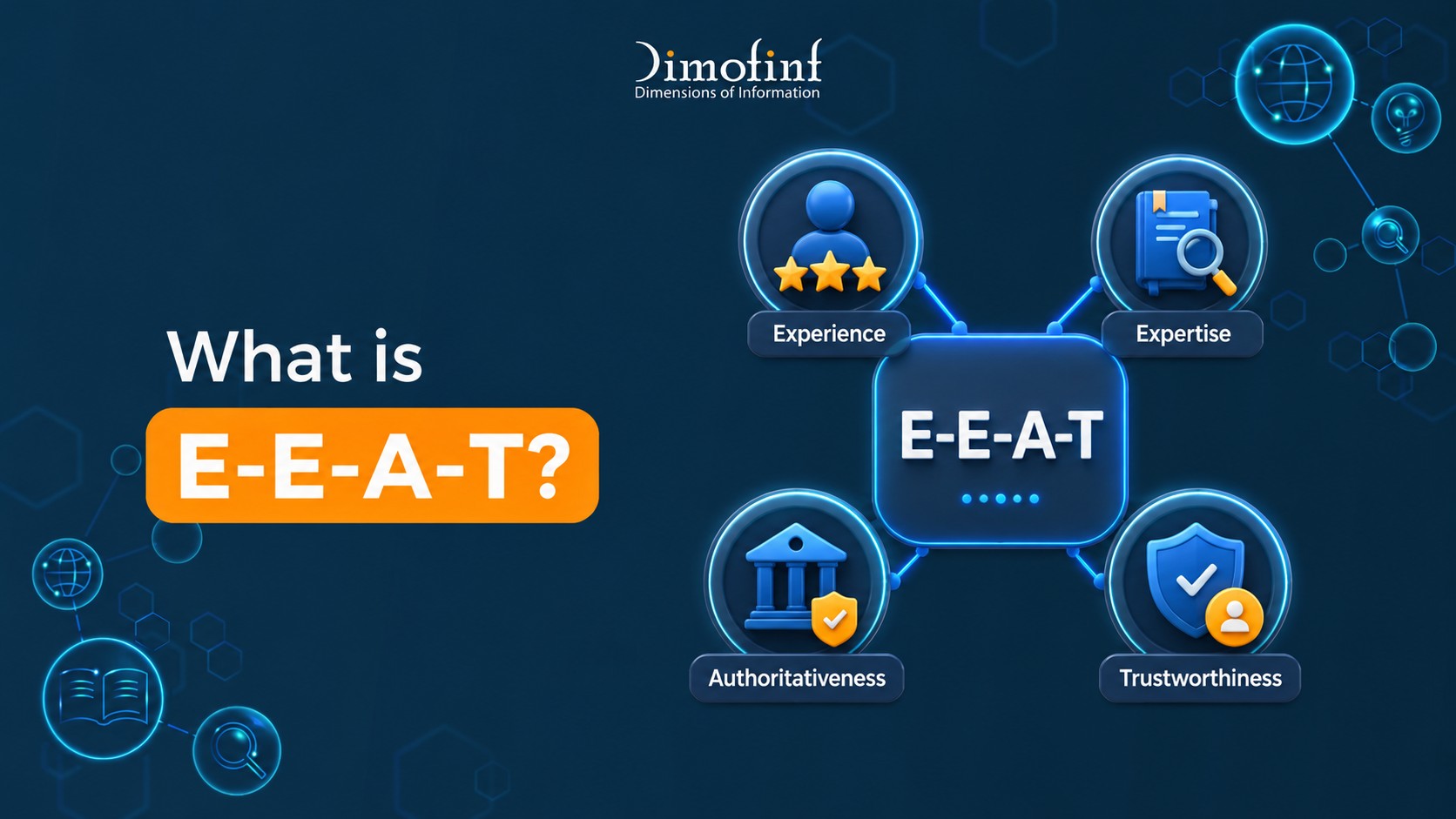
E-E-A-T stands for (Experience, Expertise, Authoritativeness, and Trustworthiness) which is a framework used by Google’s human Search Quality Raters to evaluate the credibility, safety, and quality of web content before training search algorithms to rank websites.Experience (E): Evaluates whether the creator has actual, practical experience with the topic.
- Expertise (E): Measures the author’s formal qualifications, specialized training, or subject-matter depth.
- Authoritativeness (A): Assesses your website and author reputation within your specific industry.
- Trustworthiness (T): Focuses on accuracy, transparency, and safety. Google considers it as the most critical element of E-E-A-T. Without clear contact details, secure HTTPS protocols, reliable information, and transparent business operations, high ratings in the other three pillars will not save your rankings.
| E-E-A-T Element | Core Focus | Key Demonstration Signal |
| Experience | Practical, hands-on involvement | First-person testing, original photos, case studies |
| Expertise | Formal qualifications and knowledge | Author credentials, degrees, specialized skills |
| Authoritativeness | Industry reputation and citations | Backlinks, media coverage, expert quotes |
| Trustworthiness | Accuracy, security, and transparency | SSL security, clear contact info, accurate facts |
Why is E-E-A-T important for Google rankings?
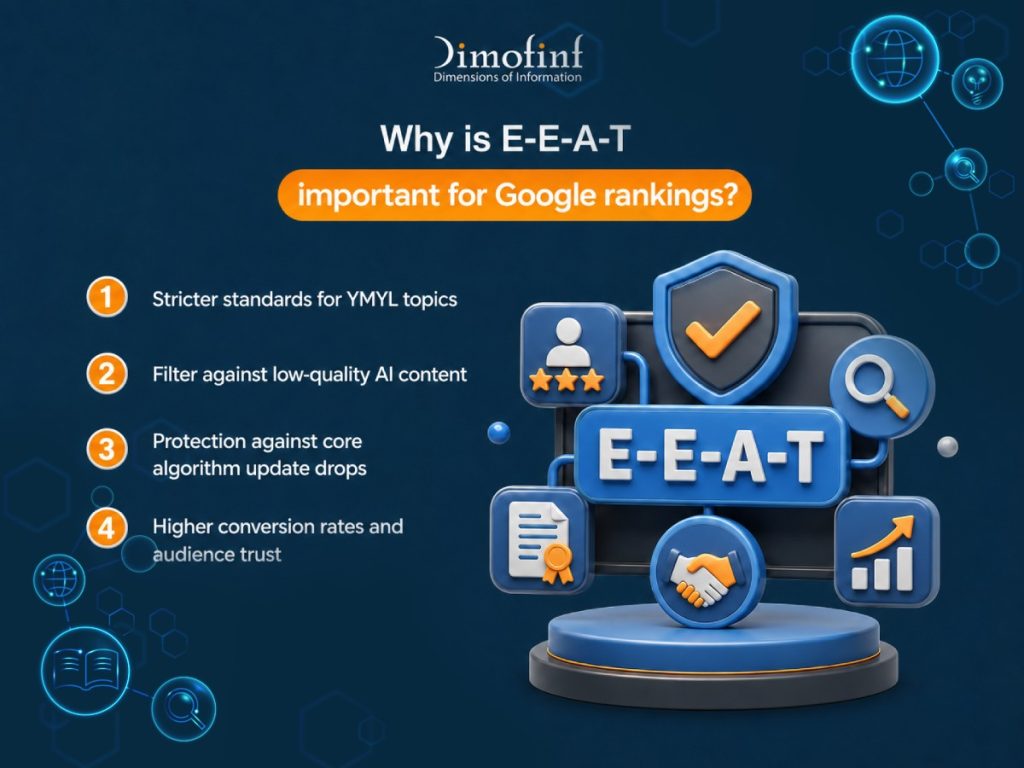
E-E-A-T is important for Google rankings because search engines prioritize delivering accurate, safe, and reliable information to users. Google uses E-E-A-T to protect searchers from misleading content, separate authentic expertise from automated spam, and reward websites that demonstrate genuine authority.
Here are the primary reasons why E-E-A-T is critical for your website’s search performance:
Stricter standards for YMYL topics:
Google applies much higher E-E-A-T standards to “Your Money or Your Life” (YMYL) websites. These are pages that cover health, legal guidance, financial advice, or core digital security and web infrastructure. If bad advice on a website could hurt someone’s health, financial stability, or data security, Google strictly demands verified expertise before granting high rankings.
Filter against low-quality AI content:
Millions of AI-generated articles are published every day without human review or real-world testing. E-E-A-T helps search algorithms reward original content written by actual practitioners while filtering out generic summaries that lack first-hand knowledge.
Protection against core algorithm update drops:
Websites that ignore E-E-A-T often suffer major traffic drops during Google core updates. Building strong trust signals creates an organic safety net that protects your rankings when search algorithms update.
Higher conversion rates and audience trust:
When you demonstrate clear authority and transparency, human visitors respond just like search engines do. Visitors are far more likely to buy services, request quotes, or subscribe to a business that clearly displays its credentials and real-world experience.
Is E-E-A-T a direct Google ranking factor?
No, E-E-A-T is not a direct Google ranking factor or a single technical metric in search algorithms. Unlike page speed, mobile friendliness, or HTTPS encryption, Google does not calculate a numerical E-E-A-T score to determine where your page ranks on search results.
Instead, E-E-A-T is an evaluation concept defined in Google quality raters guideline concept. Human raters use this framework to evaluate thousands of search result pages and provide feedback to Google’s engineering team. Google then uses that human feedback to train machine learning models and refine ranking algorithms over time.
How to improve E-E-A-T?
To improve E-E-A-T, you need to demonstrate genuine hands-on experience, showcase verified author credentials, earn backlinks from trusted industry sources, maintain business transparency, and establish a secure, fast technical foundation for your website.
- Demonstrate practical experience: Incorporate original photos, first-person testing notes, case studies, and unique walkthroughs into your content. Show readers that you have actually used the products or implemented the strategies you discuss.
- Highlight author expertise: Add detailed author bio boxes to every informational article. Include formal qualifications, degrees, professional certifications, and direct links to active social media profiles or personal author websites.
- Build industry authoritativeness: Earn citations, guest mentions, and backlinks (off-page SEO ) from established publications in your niche. When respected industry platforms reference your research or tools, search engines recognize your growing domain influence.
- Fortify sitewide trustworthiness and technical security: Publish comprehensive About Us, Contact Us, Terms of Service, and Privacy Policy pages. Secure your domain with SSL certificates, maintain high server uptime, and ensure fast page loading speeds so visitors and search bots always experience a safe connection.
What makes Google consider a website authoritative?
Google considers a website authoritative when third-party sources across the web consistently validate its credibility, expertise, and operational legitimacy. Rather than relying solely on what a website claims about itself, search engines measure authority through external trust signals, industry recognition, and technical reliability.
What practical steps can improve E-E-A-T over time?
Practical steps to improve E-E-A-T over time: auditing your content regularly, verifying author credentials, building genuine industry relationships, and maintaining a secure, highly reliable technical foundation for your domain.
- Audit and update existing content regularly: Review your top-traffic pages every few months to refresh statistics, replace dead links, update industry references, and correct obsolete facts.
- Build robust author profiles and implement Person schema: Create dedicated bio pages for every writer and editor on your team by Including their formal credentials, professional history, published works, and social profile links.
- Showcase real customer reviews and case studies: Highlight authentic testimonials, client success stories, and verified third-party reviews on your site.
- Publish original research, data, and industry insights: Conduct surveys, publish original case studies, or release industry benchmarks that other writers will naturally quote and link back to as a source.
- Establish complete corporate transparency: State your company’s physical location, customer support contact channels, ownership details, editorial guidelines, privacy policy, and terms of service to make it effortless for visitors and search raters to verify who owns and runs your website.
- Reinforce your site’s security and technical foundation: Technical errors erode trust quickly. Ensure your website runs on modern SSL/TLS encryption, operates on high-uptime servers, loads rapidly across mobile and desktop devices, and protects visitor data with robust cybersecurity protocols.
Conclusion
Understanding “what is E-E-A-T in SEO” is only the beginning. Building genuine search trust requires an ongoing commitment to quality content, verified expertise, and transparent business operations.
However, even the most authoritative content needs a reliable foundation to succeed. If your website suffers from slow loading speeds, server downtime, or unencrypted connections, search engines and users will hesitate to trust your brand. Technical performance and security are the fundamental prerequisites for all online trust signals.

Comment